
🔁 Your Resolution is Dead. Long Live the Restart.
It’s February. Your gym membership is collecting dust. The journal you bought on January 1st has three entries—all from the first week. The “new you” lasted exactly 17 days before you found yourself back on the couch, doom-scrolling at 11 PM with a bag of chips.
Welcome to the club. 92% of New Year’s resolutions fail. That’s not a statistic—it’s a massacre. And the fitness industry, the self-help gurus, and the productivity app developers are counting on it. They make money from your January enthusiasm and your February guilt.
But here’s the thing they won’t tell you: January is a terrible time to change your life. The hype cycle is working against you. The crowds are overwhelming. The pressure is artificial. And your motivation is sugar-high energy that crashes harder than a crypto portfolio.
February? That’s when the real players make their move. Let’s talk about why—and how you’re going to restart correctly this time.
📉 The Hype Cycle: Why January is a Trap
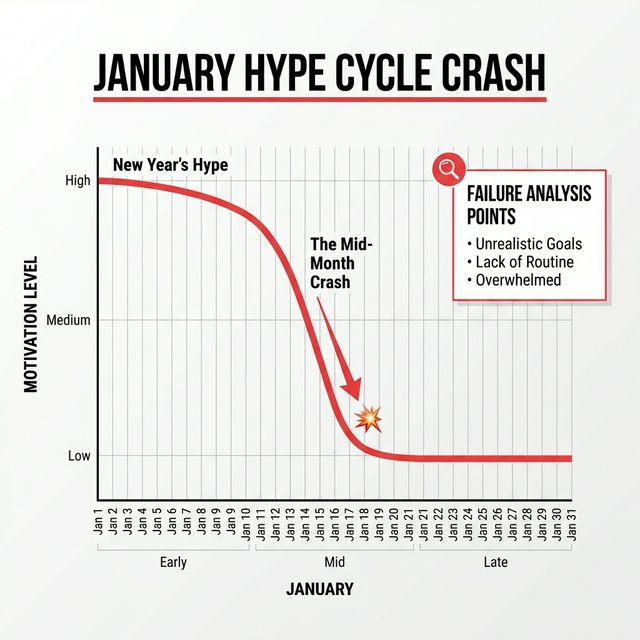
January 1st is the biggest lie in personal development. Everyone starts. Almost no one finishes. Here’s why:
1. The Motivation Myth
You’re not motivated in January. You’re emotionally caffeinated. The New Year energy is a dopamine spike—a collective sugar rush fueled by champagne toasts and Instagram captions. Motivation is a feeling. Feelings fade. Discipline is a skill. Skills take time to build. You can’t build a skill in a dopamine storm.
2. The Overcommitment Trap
“I’m going to work out 6 days a week, wake up at 5 AM, start a business, learn Spanish, and read 52 books.” Sound familiar? You didn’t make a resolution—you made a suicide pact with your calendar. The more goals you set, the more you fragment your willpower. Willpower is finite. You burned through your tank by January 15th.
3. The Environment Problem
January gyms are packed with people who will be gone by Valentine’s Day. The noise, the wait times, the energy—it’s chaos. You’re trying to build a habit in a place that feels like a nightclub. Habits need calm, not chaos. February is when the gym returns to its natural state: quiet, focused, and ready for the committed.
Key Insight: The best time to start is when everyone else has quit. February is the real New Year.
🔬 Analysis: Failure is Data, Not Defeat
If your January resolution crashed, you have two options: wallow in guilt, or autopsy the failure. Smart people choose the second.
The Post-Mortem Framework
Ask yourself these questions with brutal honesty:
- What broke first? Was it the routine, the motivation, or the environment? Identify the weak link.
- When did it break? Day 7? Day 14? Day 21? There are patterns. Most people fail at the two-week mark when novelty wears off.
- Why didn’t I recover? Missing one day is not failure. Not restarting is failure. What stopped you from getting back up?
Failure isn’t the opposite of success—it’s the prerequisite. Every failed attempt is a data point. Collect enough data points, and you have a map. The map shows you where not to step.
The Guilt Trap
Guilt is useless. It’s a mental tax that takes your energy without giving you anything in return. You feel bad, so you eat badly, so you feel worse, so you give up. It’s a death spiral. Cut the guilt. Analyze the failure. Move forward.
“Fall seven times, stand up eight.” — Japanese Proverb
🎯 The Reset: One Goal for February
Here’s the protocol that actually works:
Step 1: Delete All but One
You don’t need 10 goals. You don’t even need 3. You need ONE. One goal that, if achieved, would make everything else easier or unnecessary. This is your keystone goal.
- If your goal is “get in shape,” your keystone might be: “Go to the gym 3 times per week.”
- If your goal is “get rich,” your keystone might be: “DM 10 potential clients every day.”
- If your goal is “be more focused,” your keystone might be: “No phone for the first hour of the day.”
Step 2: Make It Stupid Easy
Your goal should be so small that failing feels embarrassing. “Go to the gym” becomes “put on gym clothes.” “Write a book” becomes “write one sentence.” The goal isn’t to be productive. The goal is to show up. Showing up builds identity. Identity drives behavior.
Step 3: Attach It to Something You Already Do
This is called habit stacking. After I [existing habit], I will [new habit]. Example: “After I pour my morning coffee, I will write for 10 minutes.” The anchor habit triggers the new behavior. No willpower required.
| January Approach | February Protocol |
|---|---|
| 10 goals | 1 keystone goal |
| Motivation-driven | System-driven |
| All-or-nothing | Stupid easy start |
| Relies on willpower | Uses habit stacking |
| Social pressure to start | Quiet, personal commitment |
⚙️ The System: Input Goals vs. Output Goals

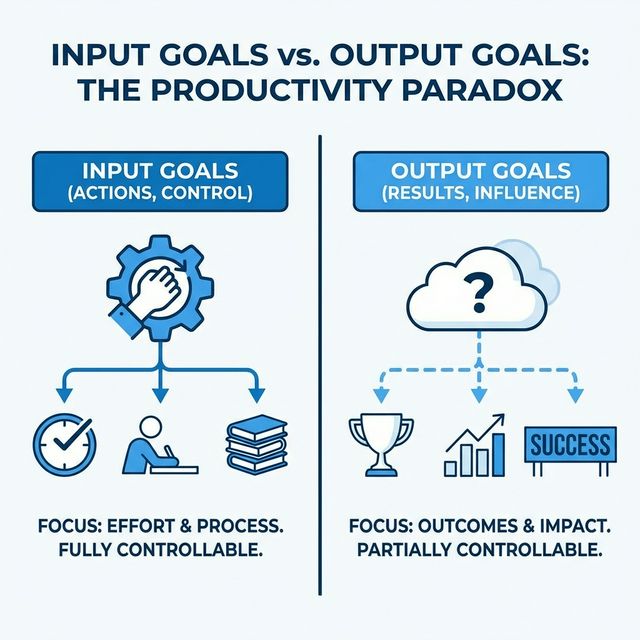
This is where most people go wrong—and where you’re going to get it right.
The Problem with Output Goals
An output goal is a result: “Lose 20 pounds.” “Make $10,000/month.” “Get 10,000 followers.” The problem? You don’t control the output. You can do everything right and still not hit the number. Results depend on timing, luck, market conditions, and a thousand variables outside your influence. When you tie your success to something you can’t control, you’re setting yourself up for frustration.
The Power of Input Goals
An input goal is an action: “Work out 4 times this week.” “Reach out to 10 clients today.” “Post one piece of content daily.” You control the input. You can guarantee execution. And here’s the secret: consistent inputs inevitably produce outputs. If you lift weights 4 times a week for 6 months, you will get stronger. The result is a lagging indicator of your behavior.
The Identity Shift
Input goals also change your identity. When you focus on “going to the gym 4x/week,” you start seeing yourself as someone who works out. That identity protects the habit. You don’t skip workouts because “that’s not who you are.” Behavior follows identity. Build the identity first.
“You do not rise to the level of your goals. You fall to the level of your systems.” — James Clear
❓ Frequently Asked Questions
Why do most resolutions fail?
They rely on motivation instead of systems. Motivation is temporary—it’s a spark, not a fire. Systems are designed to work even when you don’t feel like it. If your plan requires you to “feel like it,” it’s not a plan. It’s a wish.
How do I restart my goals?
Start smaller than you think you need to. Aim for consistency, not intensity. Pick one goal. Attach it to an existing habit. Make it so easy that failure would be embarrassing. Then show up. Every. Single. Day.
Is February too late to start?
No. The best time to plant a tree was 20 years ago. The second best time is now. February isn’t “late”—it’s strategic. The crowds are gone. The hype has faded. You’re not competing with a million other resolution-makers. You’re starting when it actually counts: when no one is watching.
🚀 Conclusion: Your Move
January is over. Good riddance.
If you crashed and burned, congratulations—you now have data. You know what doesn’t work. You know where you break. You know what the enemy looks like.
February is your restart. Not with 10 goals and a vision board. Not with motivational quotes and a new planner. With one keystone goal, a system that doesn’t require willpower, and the discipline to show up when no one else is watching.
The gyms are empty. The hype is dead. The pretenders have gone home.
Don’t waste it scrolling. Don’t waste it “planning.” Pick one thing. Start today. Be relentless.
Disclaimer: This is for informational purposes only. Consult a professional before making significant lifestyle changes.





One Comment